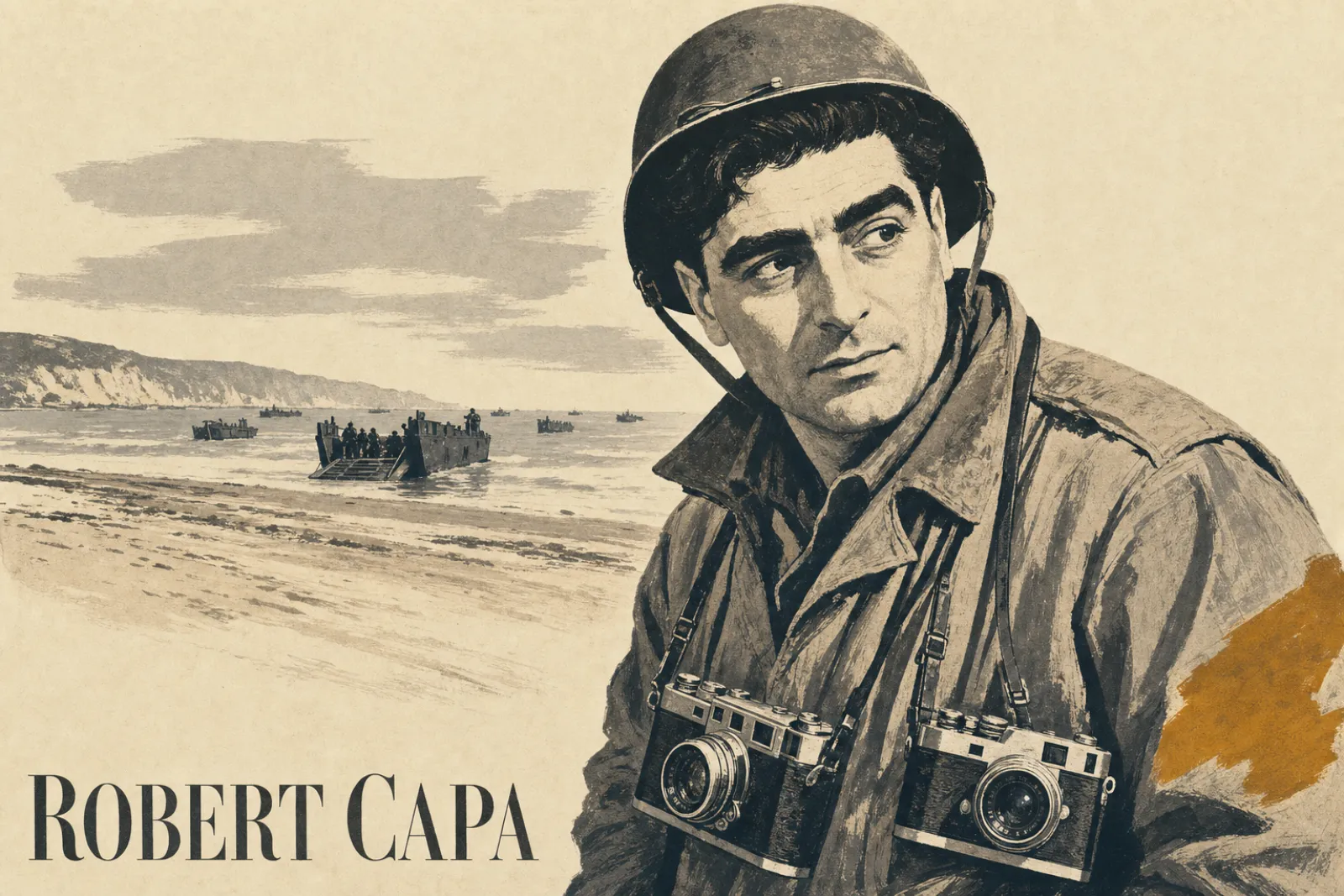
Robert Capa (1913 to 1954) was a Hungarian-born photojournalist who covered five wars with 35mm cameras, from the Spanish Civil War in 1936 to the French war in Indochina, where he was killed by a landmine. He worked for Life and Collier’s, co-founded the Magnum Photos agency in 1947, and is known for two sets of pictures: a falling Republican militiaman in Spain and the American landing on Omaha Beach on D-Day.
Capa learned the trade in the Berlin picture agencies and remade himself in Paris, where he shared a darkroom with Henri Cartier-Bresson and David Seymour, known as Chim. His closest working partner in those years was the photographer Gerda Taro. The three friends of the Paris darkroom, with George Rodger and William Vandivert, later founded Magnum as a cooperative owned by its photographers. For later photographers who took the same risks in other wars, see Don McCullin and James Nachtwey.
Endre Friedmann becomes Robert Capa
He was born Endre Ernő Friedmann in Budapest on October 22, 1913, to Jewish parents. As a teenager he was arrested by the Hungarian secret police for radical political activity and released on condition that he leave the country. He went to Berlin, studied at the Deutsche Hochschule für Politik, and worked as a darkroom assistant at the Dephot agency. His first published photograph showed Leon Trotsky giving a speech in Copenhagen in 1932.
When the Nazi Party came to power in 1933 he left for Paris. There he met Gerta Pohorylle, a German Jewish woman who became the photographer Gerda Taro. Around 1935 the two invented “Robert Capa”, supposedly a famous American photographer, and Friedmann at first posed as the man’s agent. The invented name got round the growing prejudice of the time and appealed to the better-paying American market. Both of them published work under it before Taro worked under her own name.
Spain, 1936: the picture that made the name
From 1936 Capa covered the Spanish Civil War, often with Taro and with Chim. On September 5, 1936, he made the photograph known as “The Falling Soldier”. It was published in the French magazine Vu on September 23, 1936, and in Life on July 12, 1937. In 1938 the British magazine Picture Post called him the greatest war photographer in the world.
Taro was killed in July 1937 during the Republican retreat at the battle of Brunete, when a tank collided with the car carrying her. In 1938 Capa went to China and photographed the resistance to the Japanese invasion from Hankou. Life published the pictures on May 23, 1938.
Wondering how a set of news pictures becomes a story on the page? How to create a photo essay explains how pictures are chosen and ordered.
From Naples to Omaha Beach to Leipzig
Capa moved to New York in 1939. During the Second World War he photographed for Collier’s and then for Life, in North Africa, Italy, France and Germany. He has been described as the only “enemy alien” photographer working with the Allies.
On June 6, 1944, he landed on Omaha Beach with the 16th Infantry Regiment of the 1st Infantry Division, carrying two Contax II cameras with 50mm lenses. Eleven frames survive. Life published a selection on June 19, 1944, with a caption describing them as slightly out of focus. They became known as “The Magnificent Eleven”.
He went on through France with the Allied advance, photographing in Chartres in August 1944 and at the liberation of Paris. On April 18, 1945, in Leipzig, he photographed an American machine gunner, Raymond J. Bowman, killed by a sniper on an apartment balcony. Life ran the picture on May 14, 1945.
Magnum, Russia, Israel and Indochina
In 1947 General Dwight D. Eisenhower awarded Capa the Medal of Freedom for his war photographs. The same year he published a memoir, “Slightly Out of Focus”, helped found Magnum Photos, and travelled through the Soviet Union with the writer John Steinbeck, photographing Moscow, Kyiv, Tbilisi, Batumi and the ruins of Stalingrad for Steinbeck’s book “A Russian Journal”. He photographed the founding of Israel and the war that followed for Irwin Shaw’s book “Report on Israel”. He became president of Magnum in 1952.
In 1954 he went to Indochina for Life. On May 25, 1954, in Thái Bình province, he stepped on a landmine while photographing a French advance and was killed. He was 40. France awarded him the Croix de Guerre with Palm after his death, and the Robert Capa Gold Medal was established in 1955. His younger brother Cornell Capa, also a photographer, founded the International Center of Photography in New York in 1974.
Curious what this work involves as a living? Photojournalism as a career describes the job, and the guide to photojournalism covers the practice.
How Capa’s pictures work
- Small cameras, normal lenses. On D-Day he carried two Contax II bodies with 50mm lenses. A 50mm lens does not reach across a battlefield. To fill the frame with a soldier, the photographer has to be standing near that soldier.
- The same position as the subject. The Omaha Beach pictures were made alongside the infantry he landed with, in the first hours of the assault. The viewpoint is that of a participant, and that is why they read as experience and not as a record made from a safe distance.
- Imperfection accepted. The D-Day frames are not sharp. Life itself called them slightly out of focus. Sharpness mattered less than being there, and the blur became part of how the pictures communicate. The site’s page on camera shake explains the mechanics. Capa’s frames show the one case where nobody would ask for them to be fixed.
- People before hardware. His subjects are individual soldiers and civilians: a militiaman, a man in the surf, a woman paraded through the streets, a gunner on a balcony. The scale of the war is implied by one person’s situation.
- Two cameras loaded. He went ashore on D-Day with two camera bodies. A second body means a photographer can keep working when the first roll runs out. The habit survives in every documentary photographer who carries a second body.
- Captions carry weight. The stories told about his best-known pictures have been disputed for decades. That is a lesson in itself about how captions are written and how much a picture depends on the words beside it.
Asking what a photographer owes the people in pictures like these, and the people who look at them? Photography etiquette and ethics sets out the questions.
Photographs to look for
- The Falling Soldier (1936). Full title “Loyalist Militiaman at the Moment of Death, Cerro Muriano, September 5, 1936”. A soldier collapses backward, his rifle slipping from his right hand. It is the picture on which his reputation was built, and the one most argued over.
- The Magnificent Eleven (1944). The surviving frames from Omaha Beach. The best known is called “The Face in the Surf”, and the soldier in it has been identified as either Huston Riley or Edward Regan. Look at how the lack of sharpness adds to the sense of the event.
- The Shaved Woman of Chartres (1944). Made on August 16, 1944. A woman accused of collaboration, her head shaved, is paraded through the streets carrying her baby. It shows the liberation from an angle that victory pictures leave out.
- The Picture of the Last Man to Die (1945). The Leipzig balcony photograph of Raymond J. Bowman, published under that caption. He was not the last soldier killed, since fighting went on for about two more weeks. The apartment was later preserved as a memorial called Capa House.
- The Mexican Suitcase. Not one picture but three boxes holding about 4,500 negatives of the Spanish Civil War by Capa, Taro and Chim, missing from 1939 and delivered to the International Center of Photography in December 2007. They show whole rolls, and so how each photographer worked through a situation.
Try this: one normal lens, three distances
This takes about 15 minutes and is done somewhere safe and ordinary: a market, a sports practice, a kitchen where someone is cooking, with the person’s agreement.
- Use one focal length close to normal. On a phone, use the main lens. Do not zoom at any point.
- Choose one person who is busy with a task.
- Make five frames from about six metres, five from about three metres, and five from about one metre. Move your feet to change the framing.
- At the closest distance, get down to the height of the person’s hands or eyes.
- Do not delete blurred frames.
Compare the three sets. Note at which distance the picture stops being about a place and starts being about a person, and whether any blurred frame says more than the sharp ones.
Want the general principle behind getting closer? Fill the frame explains when moving in strengthens a picture and when it does not.
Questions people ask about Robert Capa
Was The Falling Soldier staged?
Its authenticity has been questioned since the 1970s. Researchers, among them José Manuel Susperregui, have argued that it was made at Espejo, about 50 kilometres from Cerro Muriano, and that other pictures from the same series were staged. The identification of the man as Federico Borrell García is also contested, and no negative of the picture was found in the Mexican Suitcase. The biographer Richard Whelan defended the picture as genuine.
What happened to Capa’s D-Day photographs?
Capa said he took 106 pictures in the first two hours. The long-standing account is that a darkroom worker at Life’s London lab ruined most of the film in an overheated drying cabinet. The historian A. D. Coleman challenged that story as implausible, and the picture editor John Morris later conceded that it may be false and that Capa may have exposed only the frames that survive.
Was Robert Capa his real name?
No. He was born Endre Friedmann. He and Gerda Taro invented Robert Capa around 1935 as a fictional American photographer whose pictures would sell for more, and he then took the name as his own.
How did Robert Capa die?
He stepped on a landmine on May 25, 1954, in Thái Bình province in what was then French Indochina, while on assignment for Life with a French unit. He was 40 years old.
Capa is quoted on the photography quotes page, and the photographers he worked beside are listed in the A to Z of photographers.