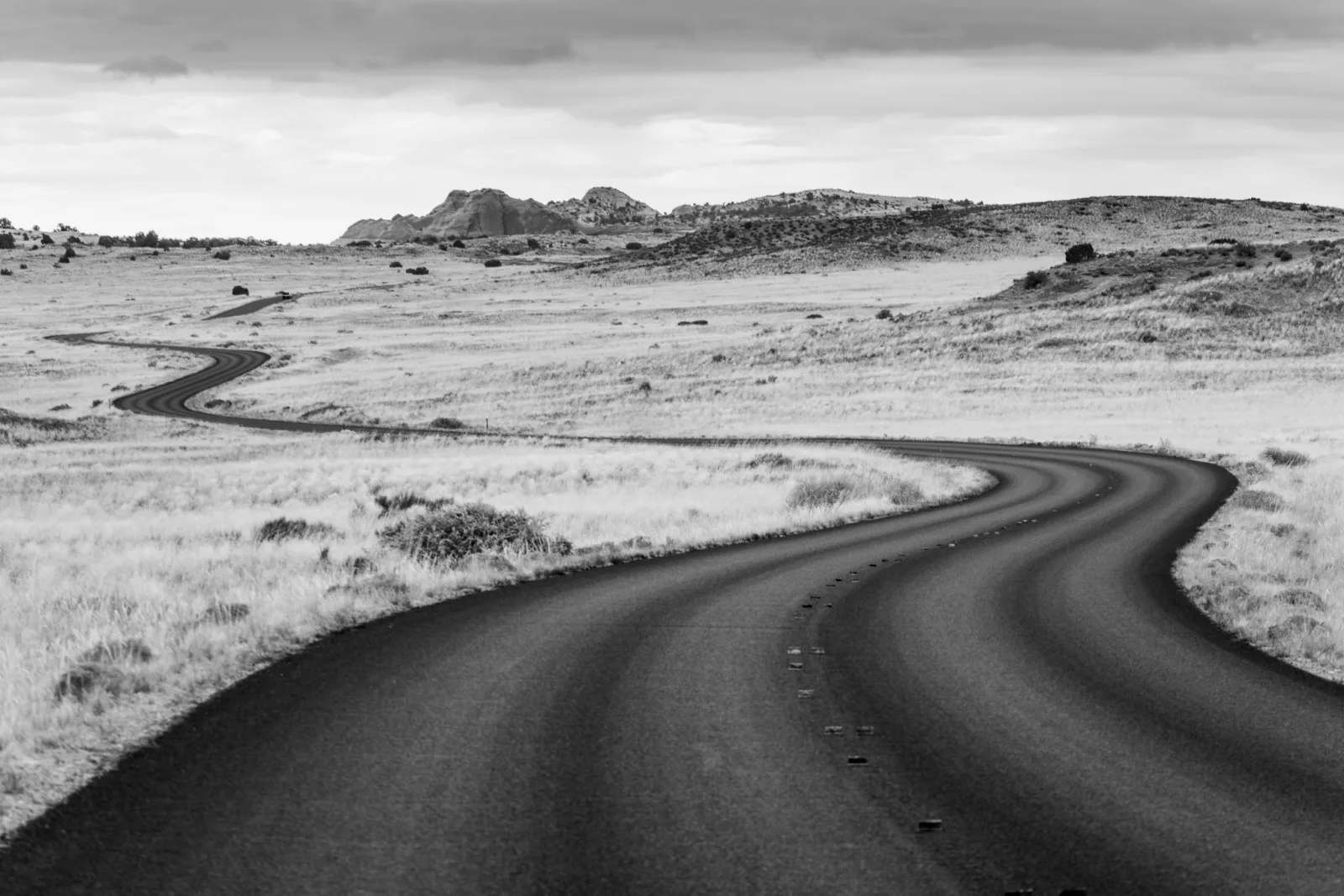
A line in photography is any edge, path, row of objects or direction of gaze that the eye follows across the frame. What a line does to a picture depends on its direction and its shape: a flat horizon feels still, a diagonal feels active, a curve feels gentle.
Lines are one of the basic building blocks of composition, alongside shape, pattern and texture. The table below sets the main types side by side, and each one has its own section after it.
| Line type | What it tends to suggest | Where to find it |
|---|---|---|
| Horizontal | Calm, rest, stability | Horizons, calm water, flat fields, a person lying down |
| Vertical | Height, strength, formality | Tree trunks, buildings, poles, standing figures |
| Diagonal | Energy, movement, tension | Slopes, staircases, fallen trees, a leaning figure |
| Curved | Softness, ease, flow | Rivers, paths, shorelines, the edge of a bowl or a wave |
| S-curve | Gentle movement that carries the eye through the frame | Winding rivers, mountain roads, a trail across a dune |
| Converging | Distance, depth, a pull toward a point | Railway tracks, long corridors, roads, rows of columns |
| Implied | A connection the viewer completes mentally | A gaze, a pointing arm, a row of separate objects |
| Leading | An invitation into the picture, toward a subject | Roads, fences, piers, rivers, shadows |
These are tendencies, not laws. A horizontal line in a storm over the sea can feel heavy and tense, and a diagonal can feel relaxed on a gentle hillside. The surrounding picture decides.
Horizontal lines
Horizontal lines run side to side. The horizon is the obvious one, but a row of fence rails, the top of a wall or the edge of a lake shore works the same way. Because they match how things rest on the ground, they read as stable and quiet.
Where you place the horizon matters. Putting it near the top gives the foreground more room, and putting it near the bottom favours the sky. Keep it level: a horizon that tilts a few degrees looks like an accident rather than a choice. If you do tilt it, tilt it enough that it is clearly deliberate.
Vertical lines
Vertical lines run up and down: tree trunks, lampposts, tall buildings, a person standing. They suggest height and strength, and a group of them in a row creates rhythm, as in a forest or a colonnade.
When you aim the camera upward at a tall building, the verticals lean inward and the building seems to fall backward. Sometimes that is a useful effect and sometimes it looks like a mistake, so decide before you press the shutter. Keeping the camera level keeps verticals parallel, so step back or find a higher position until the building fits without tilting up. How to photograph architecture and buildings has a section on managing converging verticals.
Diagonal lines
Diagonals are lines that slant across the frame, neither level nor upright. They make a picture feel active because they imply motion, either something moving along the line or something about to fall. Staircases, a slope climbing a hillside, a branch crossing the frame and a shadow stretching across a street all work.
You can create a diagonal by changing your position or by tilting the camera. The top of a wall that runs level across the frame when you stand square to it becomes a diagonal if you step to one side and shoot along it. Photography angles covers how camera position changes the lines you get.
Curved lines
Curves feel softer than straight lines. A river bend, a winding path, the rim of a cup, the edge of a dune or the arc of a bridge all let the eye travel without stopping at corners.
Curves are often strongest when they contrast with something straight. A curved road cutting through a grid of fields stands out because the shapes around it do not curve.
S-curves
An S-curve bends one way and then the other. Because the eye follows it through two turns, it tends to stay in the picture longer than it would on a straight line. A river that meanders across a valley, a road on a mountainside or a trail across sand gives you one.
The best views for S-curves are usually from above or from a raised position, because from ground level a winding path flattens into a short stretch. A higher viewpoint shows more of the bends.
Converging lines
Parallel lines that run away from you appear to meet at a point in the distance. Railway tracks are the standard example, but a long corridor, a straight road, the edges of a bridge or a row of columns do the same thing. Your brain reads the convergence as depth, which is why converging lines add a three-dimensional feel to a flat image. Depth in photography looks at the other ways to build it.
A wide-angle lens makes convergence look stronger, because it takes in the near part of each line, where the lines sit far apart in the frame, as well as the far part. A telephoto lens shows only the distant part of the same lines, where they are already close together, so the scene looks flatter. The perspective itself comes from where you stand, not from the lens. Lens compression explains why.
Implied lines
An implied line is one that is not drawn anywhere in the frame but that the viewer feels. You get one whenever the eye connects points that are not physically joined. Common sources are:
- A gaze. When a person or animal looks toward something, the viewer looks along the same path, even across empty space.
- A pointing arm, hand or leaning body. The direction of the gesture sets the line.
- A row of separate objects. Birds on a wire, stepping stones, lamps down a street or a line of boats at anchor read as one line, even with gaps between them.
- Motion. A runner, a car or a bird in flight creates a line along the path it is about to travel.
Implied lines are easy to create by accident. If a subject looks out of the frame, the viewer’s eye follows, and the picture seems to point away from itself. Leave room in front of a gaze or a moving subject so the line has somewhere to go inside the frame.
Leading lines
A leading line is a line that pulls the eye into the picture and toward a subject, like a path, a fence, a pier or a shoreline. It is the use of line that gets the most attention, and it has its own pages.
Want a line to carry the eye to a subject? Leading lines in photography covers where to place one, what to point it at and how to find one almost anywhere.
How to make a line stronger
A line works when it is clear and when nothing weakens it. These changes help:
- Move your viewpoint. A few steps to one side can turn a faint line into a clean one, or a straight line into a diagonal. Crouching or climbing changes how steeply a line recedes.
- Change the focal length and your distance. A wide-angle lens used close to the start of a line makes it sweep and converge sharply. A longer lens from farther back shows the same lines closer to parallel. Focal length explains the difference in field of view.
- Use side light. Light that crosses a surface at a low angle makes edges and ridges cast shadows, and those shadows draw the line. A road edge, a fence or a ripple in sand shows much more clearly in low evening or morning light than at midday.
- Use shadows as lines. A long shadow can be a line on its own. Shadow photography goes further.
- Remove competing detail. Crop or reframe so nothing sits across the line or distracts from it.
- Give it a start and an end. A line that begins near the edge of the frame and finishes at something of interest feels purposeful.
Common mistakes
A line carries the eye out of the frame. A road or fence that runs off the edge with nothing to stop it sends the viewer away. Fix: end the line on a subject, or reframe so it ends inside the picture.
A tilted horizon. A horizon a few degrees off level looks like a mistake. Fix: check the horizon in the viewfinder, use the camera’s grid if it has one, and straighten it later if needed. How to crop photos covers straightening and what it costs at the corners.
Two lines competing. Two strong lines of equal weight pull the eye in two directions. Fix: pick the one that matters and let the other fade, by changing position, cropping or choosing a different time of day.
Lines that cut through a subject. A pole or wire that seems to grow out of someone’s head is a line placed in the wrong spot. Fix: take a step sideways.
Seeing only one kind of line. Looking for just leading lines hides the horizontals, verticals and curves that are already there. Fix: scan the scene for each type in turn before you choose.
Wondering where a line sits among the other ideas? Photography composition sets it beside framing, balance and negative space.
Which part of the frame does the eye go to first? Visual hierarchy explains how lines, contrast and size compete for attention.
Try this
Spend ten minutes on one street, in one park or around your home. Pick a type of line from the table and make five pictures that each use it, from five different positions. Then repeat with a second type for another five. When you look at the pictures afterward, notice which ones feel calm, which feel active and which ones send your eye out of the frame. Delete the weakest and keep the clearest from each type.
Frequently asked questions
What is the definition of line in photography?
A line is any edge, path, row of objects or direction of gaze that the eye follows across a photograph. It may be solid, like a road, or implied, like the direction a person is looking.
What are the types of line in photography?
The main types are horizontal, vertical, diagonal, curved, S-curve, converging, implied and leading lines. They are described by direction and shape, and they often overlap: a road can be diagonal, converging and leading at once.
What do curved lines do in a photograph?
Curved lines tend to feel softer and more flowing than straight ones, and they let the eye move through the frame without stopping at corners. An S-curve tends to hold attention longer because the eye follows two turns.
What is an implied line?
An implied line is a line the viewer feels but that is not drawn in the picture. A gaze, a pointing arm or a row of separate objects can create one, because the eye connects the points.
How do I find lines in a scene?
Look for edges first: horizons, roads, fences, shorelines, walls and shadows. Then change your position and notice how each line changes direction or strength before you pick your viewpoint.
What is the difference between a line and a leading line?
Line is the general element: any path the eye follows. A leading line is one use of it, where the line draws the eye into the picture toward a subject.